
Metro Excavation Reanalysis in Taipei, Taiwan
Updated: Jul 16
Reanalysis of metro excavation in Taipei with diaphragm wall and steel struts
Metro Excavation Reanalysis in Taipei, Taiwan
An 18 m deep metro excavation in Taipei supported by a 1.0 m reinforced concrete diaphragm wall and multiple levels of steel struts was reanalyzed using the DeepEX platform.
The excavation, constructed in soft to medium stiff clays, was originally presented by Hsiao-Chou Chao, Richard N. Hwang, and Chung-Tien Chin of Moh and Associates during the Earth Retention Conference 3.
In the original publication, the authors discussed a methodology for correcting inclinometer displacements in excavations where the instruments did not extend below the diaphragm wall toe, a common challenge in deep excavations embedded in soft clay deposits.
The objective of this study was to reproduce the excavation using DeepEX and compare the computed wall displacements and strut reactions against the published finite element analysis and field measurements.
Excavation and Support System
The excavation was supported by:
A 1.0 m thick reinforced concrete diaphragm wall
Five levels of steel struts
Double H-beam strut sections with intermediate bracing
The excavation was carried out in predominantly clayey soils with soft to medium stiff consistency. The assumed soil properties used in the reanalysis are summarized in Table 1.

Clay Modeling Approach
In DeepEX, clay behavior can be modeled using assumptions that simulate both overconsolidated (OC) and normally consolidated (NC) response.
In this analysis:
The undrained shear strength was treated as an upper cutoff value
The exact stress-strain response was controlled by the defined Overconsolidation Ratio (OCR)
Peak friction angles were used to define the OC response envelope
Constant volume friction angles governed the NC behavior
This approach allows the model to capture the transition between overconsolidated and normally consolidated clay behavior more realistically during excavation unloading and wall deformation.
Comparison of Strut Reactions
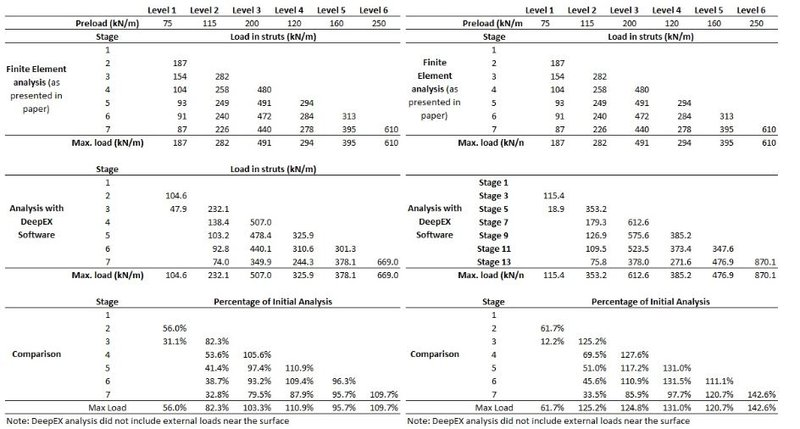
Tables 2 and 3 compare the computed strut reactions obtained from DeepEX against the published finite element analysis.
The results showed that:
OCR assumptions significantly influenced predicted support loads
Strut reactions could vary by as much as 40% depending on whether the soils were modeled as slightly OC or mostly NC
Despite these variations, the DeepEX results remained reasonably comparable with the published FEM analysis
Table 2 and 3: Comparison of support reactions assuming slightly OC soils (left) and mostly NC response (right)
Wall Displacements and FEM Response
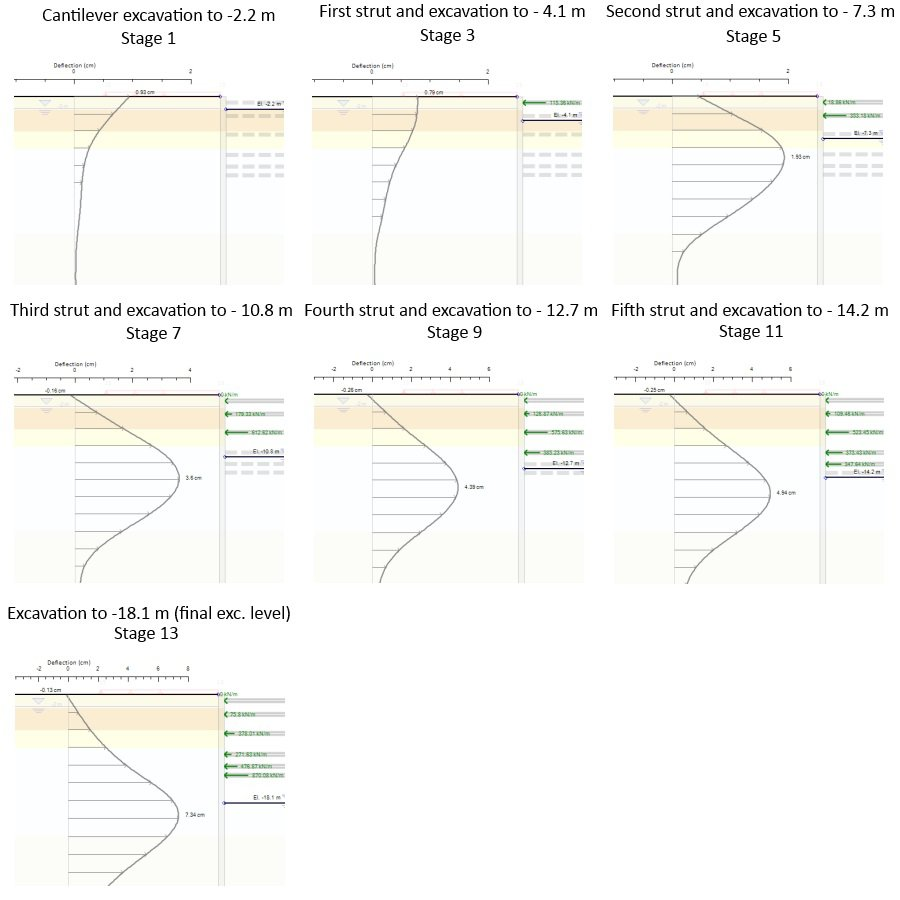
The computed wall displacements were found to correlate more closely with field measurements when the clay profile was modeled with predominantly normally consolidated behavior.
This observation highlights the importance of properly representing clay stiffness degradation and stress history in deep excavation analysis, particularly in soft urban clay deposits.
The following figure presents the final excavation stage modeled in DeepEX, including wall bending moments and horizontal wall displacements.
Modeling Recommendations for Excavations in Soft Clays
Accurate deep excavation analysis in clayey soils requires careful representation of stress history, stiffness response, and construction staging.
Key modeling considerations include:
Define realistic OCR distributions within the clay profile
Distinguish between peak and constant volume shear strength behavior
Model excavation and strut installation sequentially
Consider undrained short-term excavation behavior
Compare computed wall displacements against field instrumentation where available
Evaluate both support reactions and serviceability performance
Assess sensitivity to stiffness and OCR assumptions
For excavations in soft clays, wall displacements are often more sensitive to stiffness assumptions than overall stability calculations.
Conclusion
The Taipei excavation reanalysis demonstrates the importance of realistic clay constitutive modeling and staged excavation analysis in predicting deep excavation performance.
While support reactions varied depending on OCR assumptions, the computed DeepEX results showed reasonable agreement with the published finite element analysis and measured field performance. The study also highlights how normally consolidated clay behavior can significantly influence wall deformation patterns in deep excavations supported by diaphragm walls and strut systems.
Advanced numerical tools such as the DeepEX platform provide engineers with the ability to evaluate excavation staging, soil constitutive response, wall bending behavior, and support system interaction within a unified analysis environment.


