

Importance of Pile Cap Stiffness and Group Analysis Methods
The delays and foundation concerns associated with the Harbor Bridge Project highlighted an important aspect of deep foundation analysis: the influence of pile cap stiffness and pile group interaction on load distribution. It was reported that earlier analytical approaches did not fully capture pile cap stiffness effects, potentially leading to underestimation of pile reactions and internal forces.
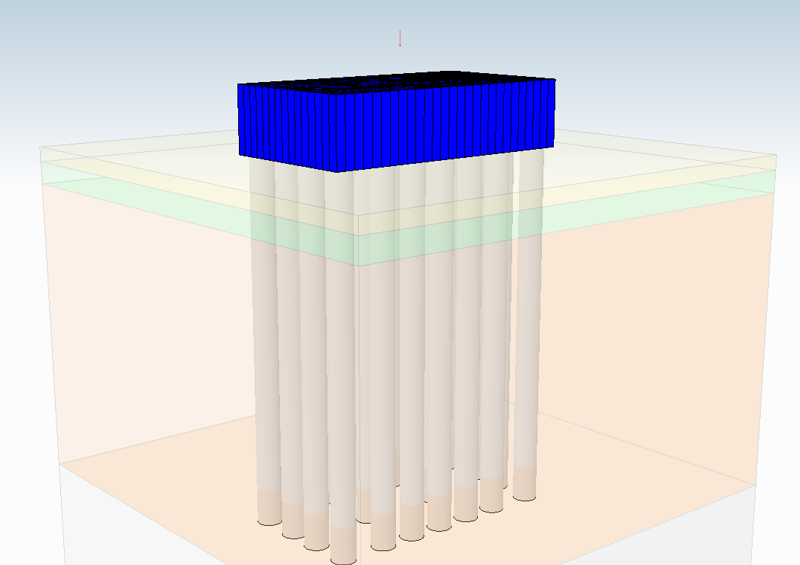
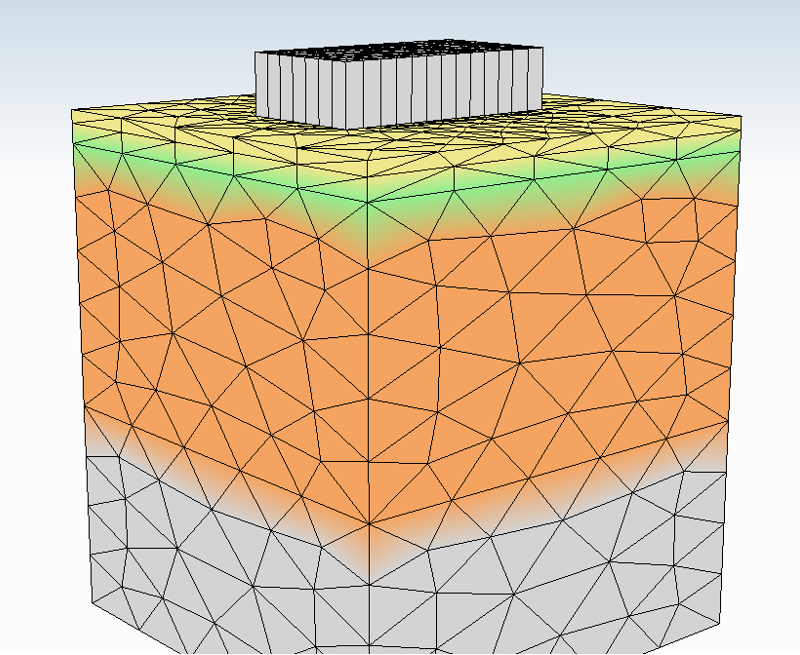
To illustrate this behavior, we developed a conceptually similar pile cap model and analyzed it using both conventional p-y spring methods and full 3D Finite Element Analysis (FEM) within the DeepFND platform.
For simplicity, a single concentrated load was applied at the center of a thick pile cap approximately 18 ft (6 m) deep. Figures 1 and 2 present the corresponding p-y spring and FEM models.
Pile Group Interaction and Load Distribution
In conventional p-y spring analysis, three-dimensional pile interaction effects are typically incorporated using empirical reduction factors applied to axial and lateral pile resistance. These interaction factors are often derived from simplified group behavior assumptions and may reflect conditions closer to ultimate loading.
In contrast, 3D FEM analysis computes pile–soil–structure interaction directly by modeling the stiffness of the pile cap, piles, and surrounding soil mass simultaneously.
Figures 3 and 4 compare the calculated vertical pile reactions obtained from the two approaches.
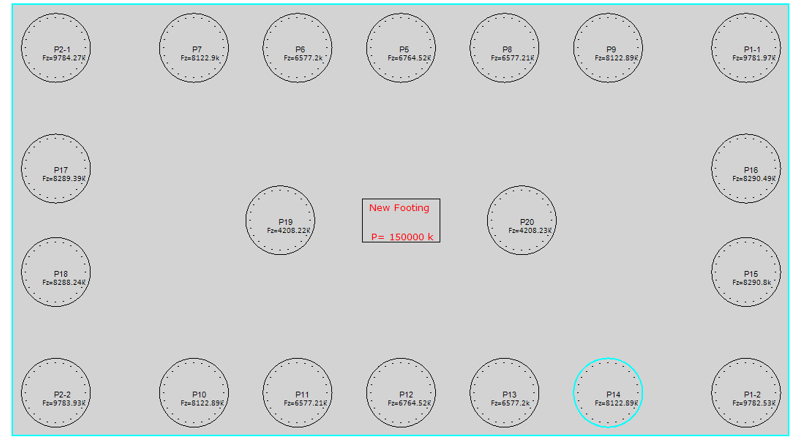
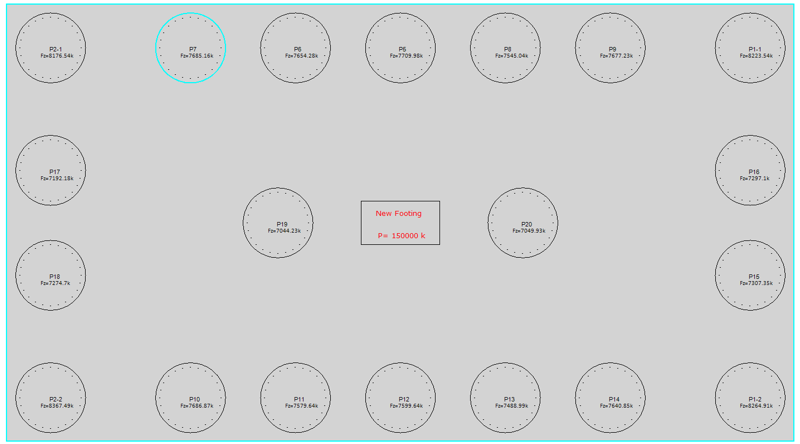
Both methods confirm that pile reactions are not uniformly distributed throughout the group. The stiffness of the pile cap influences how loads are transferred to individual piles, particularly near corners and edges.
In this example, the p-y spring model predicted larger axial reactions in the corner piles and smaller reactions in the interior piles compared to the FEM analysis. This difference is likely related to the way pile group interaction factors are imposed in conventional spring methods, which may not fully capture the actual stiffness compatibility between the pile cap and the surrounding soil system.
Modeling Considerations
Accurate pile group analysis requires careful consideration of both structural stiffness and soil–structure interaction.
Key modeling recommendations include:
Include pile cap stiffness in both axial and lateral analyses
Consider three-dimensional pile group interaction effects
Evaluate load redistribution between corner, edge, and interior piles
Assess compatibility between pile cap deformation and pile stiffness
Use FEM methods for heavily loaded or geometrically complex foundations
Compare simplified spring methods with advanced numerical analyses where appropriate
Evaluate both serviceability and ultimate loading conditions
For large bridge foundations and heavily loaded pile groups, simplified methods alone may not always capture realistic load transfer mechanisms, particularly when pile cap flexibility and complex interaction effects become significant.
Conclusion
Pile cap stiffness plays a critical role in the distribution of axial and lateral forces within pile groups. Even when overall loading appears symmetric, individual pile reactions may vary substantially depending on cap rigidity, pile spacing, and group interaction behavior.
While conventional p-y spring methods remain valuable for practical design, advanced 3D FEM analysis can provide a more realistic representation of pile–soil–structure interaction, particularly for large bridge foundations and critical infrastructure projects. Combining both approaches can help engineers better understand load redistribution mechanisms and reduce the risk of unconservative foundation designs
Let us show you how to reduce your design time by up to 90%!


