

Soil Property Estimation and Statistical Analysis in DeepEX
Make More Informed Geotechnical Design Decisions
One of the most important—and often most challenging—steps in any geotechnical project is selecting representative soil parameters.
Laboratory testing may be limited, field investigations rarely provide complete coverage, and different empirical correlations can produce significantly different estimates of soil strength and stiffness properties.
As a result, engineers are often faced with difficult questions:
Which soil parameters should be used for design?
How much uncertainty exists in the available data?
How sensitive are the results to parameter selection?
How can selected values be justified during project review?
DeepEX helps engineers answer these questions by combining soil property estimation methods with statistical analysis tools that provide greater insight into subsurface variability and parameter uncertainty.

The Challenge: Limited Data and Variable Soil Conditions
Geotechnical engineers frequently begin projects with information such as:
Standard Penetration Test (SPT) records
Borehole logs
Site investigation reports
Historical geotechnical data
While this information provides valuable insight into subsurface conditions, converting field measurements into design parameters often requires the use of empirical correlations and engineering judgment.
Different estimation methods may produce different results, making it difficult to determine which values are most appropriate for design.
How DeepEX Helps
DeepEX includes a range of established soil property estimation methods that can be used to derive engineering parameters directly from available field data.
Rather than relying on a single correlation, engineers can compare multiple estimation approaches and evaluate the resulting variability before selecting final design values.
Estimate Soil Properties from SPT Data
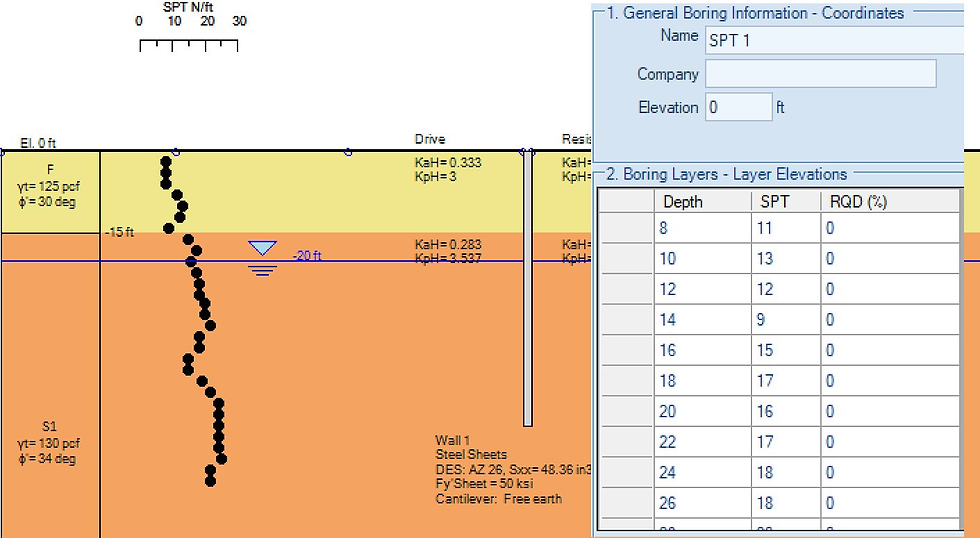
DeepEX allows users to assign Standard Penetration Test (SPT) values directly to soil layers within the project model.
Using established geotechnical correlations, the software can estimate important engineering properties such as:
Friction angle
Undrained shear strength
Cohesion
Soil density
Elastic modulus
Additional geotechnical design parameters
This helps engineers rapidly develop preliminary soil models while maintaining transparency regarding the assumptions used.
Evaluate Variability Instead of Relying on a Single Value
Soil properties naturally vary across a project site and with depth.
Selecting a single design value without understanding the variability can introduce unnecessary conservatism—or worse, underestimate project risks.
How DeepEX Helps
DeepEX performs statistical analyses of estimated soil properties, allowing engineers to evaluate:
Mean values
Minimum and maximum estimates
Standard deviations
Property distributions
Variability with depth
Variability across the project site
These analyses provide a clearer understanding of subsurface uncertainty and support more informed engineering decisions.
Select Design Parameters Based on Confidence Levels
One of the greatest benefits of statistical analysis is the ability to select design parameters using a consistent and rational methodology.
Rather than relying solely on judgment, engineers can evaluate different confidence levels and determine design values that reflect project-specific risk tolerances.
This approach helps create a more defensible basis for:
Excavation design
Retaining wall analysis
Slope stability studies
Foundation design
Ground improvement evaluations
Improve Design Reliability and Reduce Uncertainty
By combining empirical correlations with statistical evaluation, DeepEX helps engineers move beyond simple parameter estimation and better understand the uncertainty associated with subsurface conditions.
This can lead to:
✔ More informed parameter selection
✔ Improved confidence in design assumptions
✔ Better understanding of geotechnical risk
✔ More consistent design methodologies
✔ Stronger support during peer reviews and project approvals
✔ Reduced likelihood of overly conservative or unconservative designs

Why Engineers Use DeepEX for Soil Property Selection
DeepEX helps engineers transform field investigation data into meaningful design information.
By combining soil property estimation tools with statistical analysis capabilities, the software provides a structured framework for evaluating uncertainty and selecting representative design parameters.
Whether developing preliminary soil models, reviewing site investigation data, or preparing final design recommendations, DeepEX helps engineers make more informed decisions based on available evidence rather than assumptions alone.
Availability
Soil Property Estimation and Statistical Analysis capabilities are included in all current DeepEX software packages.
Let us show you how to reduce your design time by up to 90%!


