

Shoring system for a mall in Giza, Egypt
Evaluation with DeepEX Software
Introduction
This article presents a case study on the analysis of a diaphragm wall; supported excavation using DeepEX. The project involves a 5.5 m deep excavation and focuses on comparing different analysis approaches; Limit Equilibrium Method (LEM), Non-Linear analysis using elastoplastic soil springs, and Finite Element Method (FEM).
The case study examines the design of a shoring system for a mall development in Giza, Egypt. The site covers approximately 3,500 m² and is bounded by existing buildings on three sides and a street on the fourth, representing a typical constrained urban excavation. The ground elevation is about 2.7 m, requiring careful control of both stability and ground movements (Figure 1).
The objective is to evaluate how these methods approximate measured wall moments, support reactions, and displacements across construction stages, and to highlight their respective strengths and limitations.
The case study is based on published work by Eng. Khalid Walid Kamal and Eng. Reem Adel El-Naggar, providing a realistic benchmark for validation. It also illustrates how DeepEX supports staged analysis, rapid model development, and design optimization for deep excavation systems.

Figure 1. Assumed soil properties based on the original site investigation (after Kamal & El-Naggar).
Model Description
The excavation system consists of a 5.5 m deep cut supported by a diaphragm wall, analyzed using the DeepEX platform. The model incorporates staged construction and evaluates performance under different analysis frameworks. DeepEX supports a wide range of retaining systems, including diaphragm walls, soldier piles, secant piles, sheet piles, and braced or anchored support systems. Both 2D sections and 3D frames can be analyzed, enabling a detailed assessment of soil–structure interaction.
The soil profile is defined based on-site investigation data and includes layered deposits of sand and clay, with parameters such as unit weight, shear strength, friction angle, and stiffness incorporated into the analysis.
Table 1. Soil stratigraphy and engineering properties used in the model.
Elev.(m) | Soil | Soil Type | ϒtot (KN/m3) | c’ or Su (kPa) | φ (deg) | Soil Model | Eref(kPa) | exp (m) (-) |
0 | F (Fill) | Sand | 18 | 1 | 30 | Elastoplastic | 25000 | - |
-1.75 | C1 | Clay (drained) | 18 | 1 | 28 | Exponential | 15000 | 1 |
-10.00 | S1 | Sand | 18 | 1 | 34 | Elastic-Plastic | 30000 | 1 |
-12.00 | C2 | Clay (Undrained) | 18.8 | 0 | 30 | Elastic-Plastic | 15000 | - |
-15.00 | S1 | Sand | 18 | 1 | 34 | Elastic-Plastic | 30000 | - |
Modelling in DeepEX
The model was developed using the DeepEX Model Wizard (Figures 2 and 3), which allows rapid definition of geometry, support configuration, and construction stages. The software automatically generates the staged excavation sequence, significantly reducing modelling effort (Figure 4).
DeepEX also includes tools for automated optimization, enabling refinement of wall sections, support layouts, and anchor lengths to achieve efficient and economical designs.
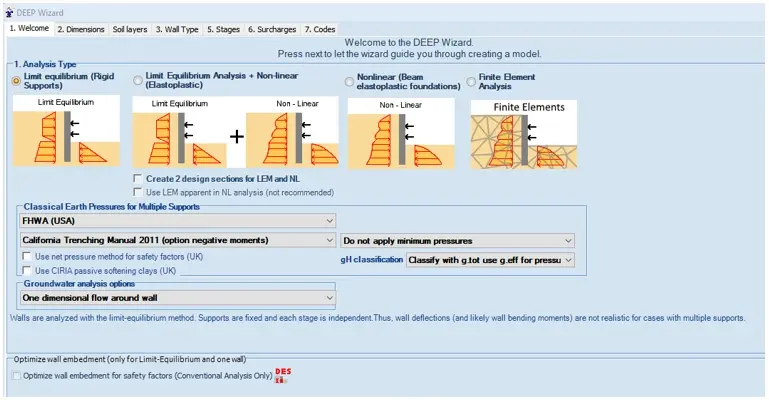
Figure 2. DeepEX Model Wizard – Analysis settings.

Figure 3. DeepEX Model Wizard – Project geometry and configuration.

Figure 4. Generated excavation model at final construction stage.
Analysis Settings
Three analysis approaches were considered:
1. Limit Equilibrium Method (LEM) – (Figure 7)
No wall friction considered
Simplified groundwater conditions
FHWA apparent earth pressure diagrams for supported stages
Beam analysis based on CALTRANS methodology (including negative moments)

Figure 5. LEM analysis settings in DeepEX.
2. Non-Linear Analysis (NL) – Winkler Springs - (Figure 8)
Soil–structure interaction represented using elastoplastic springs
Wall friction: 50%
Staged activation and deactivation of soil springs during excavation
3. Finite Element Method (FEM) - (Figure 9)
Full continuum modelling of soil mass
Wall friction: 50%
Medium mesh density
Explicit simulation of staged construction and soil–structure interaction
These methods were selected to provide a balanced comparison between simplified design approaches and more advanced numerical modelling.
Analysis Results
Method Overview
Three analysis approaches were used to assess the excavation, each capturing soil–structure interaction at a different level.
The Limit Equilibrium Method (LEM) follows a conventional approach where earth pressures (active, passive, water, and surcharge) are calculated and applied to the wall. The wall is then analyzed as a beam to obtain moments, shear forces, and support reactions. While efficient and widely used, LEM does not explicitly consider soil stiffness or construction staging in predicting deformations.
The Non-Linear (NL) analysis represents the soil using elastoplastic Winkler springs attached to the wall. These springs are activated or removed as excavation progresses, allowing the method to capture staged construction effects and the redistribution of stresses. This provides a more realistic estimate of wall displacements compared to LEM.
The Finite Element Method (FEM) models the soil as a continuous medium and simulates full soil–structure interaction. By incorporating construction stages directly, FEM provides detailed predictions of stresses, support reactions, and displacements, offering the most comprehensive assessment of excavation behavior.
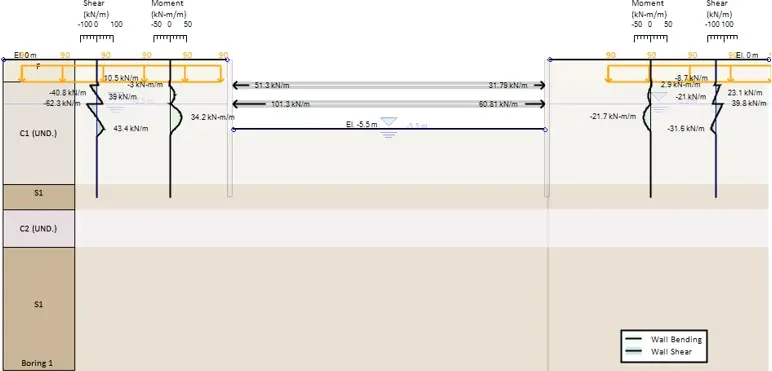
Figure 6. LEM results – wall moment and shear diagrams, support reactions (final stage).

Figure 7. NL results – wall moment and displacement profiles, support reactions (final stage).

Figure 8. FEM results – wall response, soil displacement contours, and support reactions (final stage).
Comparison of Results
Wall bending moments are broadly consistent across methods, indicating that LEM remains reliable for preliminary design of structural demand.
However, support reactions differ significantly. LEM predicts higher values due to its inherent assumption of unbalanced forces, whereas NL and FEM treat the system as fully interactive, resulting in more realistic and balanced reactions.
The most notable differences are observed in wall displacements. LEM significantly underestimates movements because it does not account for soil stiffness or construction staging. In contrast, both NL and FEM capture deformation behavior more realistically, with FEM generally predicting larger displacements due to its ability to model wall toe movements and global soil deformation.
Table: Critical results (all construction stages)
Method | Max Moment (kNm/m) | Max Shear (kN/m) | Max Displacement (cm) | Max Support Reaction (kN/m) |
LEM | 41.8 | 70.3 | 0.06 | 101.3 |
NL | 39.0 | 39.8 | 0.81 | 56.1 |
FEM | 45.9 | 51.6 | 1.77 | 57.5 |
Conclusion
This study highlights the importance of selecting an appropriate analysis method for deep excavation design.
While LEM remains a practical and efficient tool for estimating wall forces and preliminary design, it has clear limitations in predicting system behavior—particularly displacements and support reactions.
Non-linear and FEM approaches provide a more realistic representation of soil–structure interaction and staged construction, making them better suited for assessing serviceability performance and optimizing design.
DeepEX integrates all three methods within a single platform, allowing engineers to cross-check results, refine designs, and gain a deeper understanding of excavation behavior. This capability supports safer, more efficient, and better-informed design decisions in complex urban excavation projects.
Let us show you how to reduce your design time by up to 90%!


