

🌍Geoengineering Master Class #6
Slope Stability Analysis: Understanding LEM and FEM c′–φ Reduction in DeepEX
Introduction
Slope failures in natural terrain and engineered earthworks rarely develop along perfect circular arcs, particularly when soil stratigraphy and geometry become complex. In layered deposits, embankments founded on weak soils, or slopes containing benches and irregular toes, the critical failure mechanism often follows a non-circular path controlled by weaker materials and unfavorable stress conditions.
Classical circular methods remain widely used because they are efficient and reliable for homogeneous slopes. However, as noted by Talesnick and Baker, restricting the analysis to circular slip surfaces may overlook the true critical mechanism in stratified or heterogeneous ground conditions.
To address these limitations, modern limit equilibrium methods allow the evaluation of arbitrary slip geometries capable of adapting to weak interfaces and complex slope configurations. In this Geoengineering Master Class, a practical workflow is presented for analyzing non-circular failure surfaces in DeepEX using rigorous limit equilibrium methods and automatic search procedures.
What You Will Learn
In the accompanying DeepEX demonstration, you will learn how to:
Build a baseline circular slope stability model
Identify geological and geometric conditions that favor non-circular failure
Switch from circular to non-circular slip surface analysis
Use automatic search procedures to locate the critical failure mechanism
Compare circular and non-circular solutions
Interpret how weak layers influence the failure path and factor of safety
Evaluate when non-circular analysis is necessary for design
By the end of the tutorial, you will be able to apply non-circular slope stability analysis confidently in practical engineering projects.
Why Non-Circular Failure Surfaces Matter
For simple and relatively homogeneous slopes, circular slip surfaces often provide reasonable and sometimes conservative stability estimates. This explains the continued use of classical approaches such as Bishop’s Simplified Method.
However, real slopes rarely behave this ideally. In layered soils or profiles with strong–weak material contrasts, the actual failure mechanism tends to follow weaker interfaces instead of a smooth circular arc. Circular analyses are therefore not necessarily incorrect, but they may artificially constrain the possible failure kinematics.
This limitation motivated the development of generalized limit equilibrium formulations capable of analyzing arbitrary slip surfaces. Over time, these methods evolved to include polygonal failure surfaces, non-vertical slices, and automated search procedures capable of identifying the most critical mechanism in complex slopes.
Today, non-circular analyses are widely used for:
Stratified soil profiles
Embankments on soft foundations
Slopes with benches or irregular geometry
Composite soil–rock systems
Excavations influenced by weak layers or interfaces
Methods Available in DeepEX
DeepEX supports several limit equilibrium methods for both circular and non-circular slope stability analyses. These methods differ mainly in how interslice forces and equilibrium conditions are treated.
· Ordinary Method of Slices (Swedish Method): The Ordinary Method of Slices satisfies moment equilibrium only and neglects interslice forces. Although computationally simple, it is generally less accurate for layered soils and complex slope geometries.
· Bishop Simplified Method: Bishop’s method satisfies moment equilibrium while simplifying interslice shear force assumptions. It is widely used for circular slip surfaces because it provides a good balance between simplicity and accuracy.
· Spencer Method: The Spencer method satisfies both force and moment equilibrium using a constant interslice force inclination. It is considered a rigorous approach and can be applied to both circular and non-circular slip surfaces.
· Morgenstern–Price Method: The Morgenstern–Price method is one of the most rigorous formulations available in DeepEX. It satisfies complete force and moment equilibrium while allowing flexible interslice force relationships.
This flexibility makes it particularly suitable for stratified and heterogeneous ground conditions, where the critical failure surface may follow weak interfaces or irregular geometries.
For the analyses presented in this study, the Morgenstern–Price method combined with the advanced automatic search procedure in DeepEX was adopted for both circular and non-circular evaluations.
Circular vs Non-Circular Analysis in DeepEX
When transitioning from circular to non-circular analysis in DeepEX, the soil properties and boundary conditions remain unchanged; however, the range of admissible failure mechanisms expands significantly.
Circular analyses constrain the failure surface to a single continuous arc. In contrast, non-circular analyses permit composite and irregular slip geometries capable of adapting to weak layers, benches, interfaces, and abrupt geometric changes.
As a result, non-circular analyses often provide a more realistic representation of slope behavior in heterogeneous ground conditions.
The results presented in Figure 1 demonstrate this behavior clearly. The circular analysis produced a factor of safety of approximately 1.16, whereas the non-circular analysis resulted in a lower factor of safety of approximately 1.04.
The reduction in stability occurs because the non-circular failure mechanism can partially follow the weaker soil interface and develop a more critical failure path. Conversely, the circular solution is forced to pass through stronger regions of the soil profile, leading to a less critical result.
These findings highlight several important engineering observations:
Non-circular failure surfaces generally align better with geological and stratigraphic features
Non-circular analyses often produce lower and more conservative factors of safety
Differences between circular and non-circular solutions become more significant in layered soils
Relying exclusively on circular analyses may overestimate stability in complex ground conditions
For practical engineering applications, it is recommended to perform both analyses. The circular solution can serve as an initial benchmark and validation check, while the non-circular solution should generally govern design when it produces a more geologically realistic and critical failure mechanism.
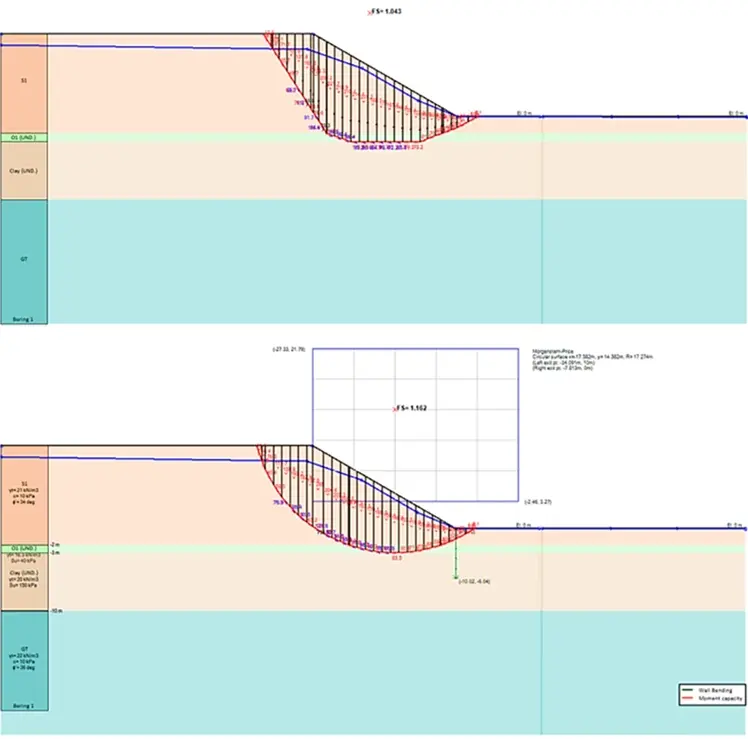
Figure 1 – Slope stability analyses of stratified ground considering (a) a non-circular slip surface (FS = 1.043) and (b) a circular slip surface (FS = 1.162).
FEM c–φ Reduction Verification
To complement the limit equilibrium analyses, a finite element method (FEM) c–φ reduction analysis was also performed. The FEM analysis produced a factor of safety of approximately 1.19 and showed a deformation pattern consistent with the non-circular failure mechanism identified in the limit equilibrium analysis. The total displacement contours highlight the development of the critical shear zone and confirm the influence of the stratified soil profile on the predicted failure mechanism (Figure 2).
The FEM results provide an independent verification of the limit equilibrium analyses and demonstrate good agreement between the predicted failure mechanisms. While the computed factor of safety is slightly higher than the non-circular limit equilibrium solution, both approaches indicate that the governing instability is controlled by the stratified soil interface and the slope geometry.

Figure 2 – Finite element method (FEM) slope stability analysis using the shear strength reduction (c–φ reduction) technique, showing total displacement contours associated with the critical failure mechanism (FS = 1.192).
Conclusion
Non-circular slope stability analysis represents an important advancement over traditional circular methods when evaluating complex slopes and stratified ground conditions. By allowing the failure surface to adapt to weak layers and irregular geometries, non-circular methods provide a more realistic representation of potential failure mechanisms.
The DeepEX workflow presented in this tutorial demonstrates how rigorous limit equilibrium methods, combined with automatic search procedures, can identify more critical and geologically consistent slip surfaces than conventional circular analyses.
Although circular methods remain valuable for preliminary assessments and validation, non-circular analyses should be considered essential whenever soil layering, weak interfaces, or complex geometries significantly influence slope behavior.
The additional FEM c–φ reduction analysis further confirmed the predicted failure mechanism and showed good agreement with the non-circular limit equilibrium solution. The total displacement contours highlighted the same critical deformation zone identified in the limit equilibrium analyses, providing increased confidence in the interpreted slope response.
Ultimately, combining circular limit equilibrium, non-circular analysis, and FEM verification provides a more robust basis for engineering judgment, safer designs, and improved understanding of slope performance under realistic ground conditions.
References
Talesnick, M., & Baker, R. (1984). Discussion of the difference between circular and general slip surface analyses for slope stability. Géotechnique, 34(3), 419–421.
Janbu, N. (1954). Application of composite slip surfaces for stability analysis. In Proceedings of the European Conference on Stability of Earth Slopes (Vol. 3, pp. 43–49). Stockholm.
Morgenstern, N. R., & Price, V. E. (1965). The analysis of the stability of general slip surfaces. Géotechnique, 15(1), 79–93.
Sarma, S. K. (1973). Stability analysis of embankments and slopes. Géotechnique, 23(3), 423–433.
Sarma, S. K. (1979). Stability analysis of embankments and slopes under seismic conditions. In Proceedings of the 7th International Conference on Soil Mechanics and Foundation Engineering (Vol. 2, pp. 347–354).
Kovári, K., & Fritz, P. (1978). Stability analysis of slopes with non-circular slip surfaces. In Proceedings of the 5th International Conference on Numerical Methods in Geomechanics (pp. 477–484).
Kovári, K., & Fritz, P. (1984). Stability analysis of slopes using non-circular slip surfaces and non-vertical slices. International Journal for Numerical and Analytical Methods in Geomechanics, 8(3), 237–250.
Yamagami, T., & Ueta, Y. (1988). Search for noncircular slip surfaces by the Morgenstern–Price method. In Proceedings of the 6th International Conference on Numerical Methods in Geomechanics (pp. 1337–1344). Innsbruck.
Hoek, E., & Bray, J. W. (1981). Rock Slope Engineering (3rd ed.). London: Institution of Mining and Metallurgy.
Javankhoshdel, S., & Bathurst, R. J. (2016). Simplified probabilistic slope stability analysis using Monte Carlo simulation. Computers and Geotechnics, 74, 1–15.
Zolfaghari, A. R., Heath, A. C., & McCombie, P. F. (2005). Simple genetic algorithm search for critical non-circular failure surface in slope stability analysis. Computers and Geotechnics, 32(3), 139–152.
Shinoda, M., Miyata, Y., & Hata, T. (2009). Reliability-based slope stability analysis using random field modeling. Soils and Foundations, 49(4), 523–538.
Ma, J., Tang, H., Hu, X., & Bobet, A. (2014). Stability analysis of slopes using particle swarm optimization and limit equilibrium methods. Engineering Geology, 174, 87–98.
Jiang, S.-H., Yamagami, T., & Li, D.-Q. (2012). Reliability analysis of slopes with spatially variable soils using random finite element method. Computers and Geotechnics, 41, 97–106.
Let us show you how to reduce your design time by up to 90%!


