

How can I define the drained and undrained clay properties in DeepEX?
- May 19
- 3 min read
Understanding the behavior of clays under different conditions is fundamental in geotechnical engineering, especially when it comes to designing safe and effective soil-structure interactions. Clays can exhibit significantly different mechanical properties depending on whether they are in a drained or undrained state. These behaviors are particularly important in scenarios involving foundations, slopes, and embankments. The ability to accurately simulate these conditions is crucial for reliable analysis and design. DeepEX, a widely-used geotechnical software, provides robust tools for modeling both drained and undrained behavior of clays. This article explores how to input and simulate these behaviors in DeepEX, ensuring comprehensive analysis for both short-term and long-term conditions.
Undrained Behavior of Clays
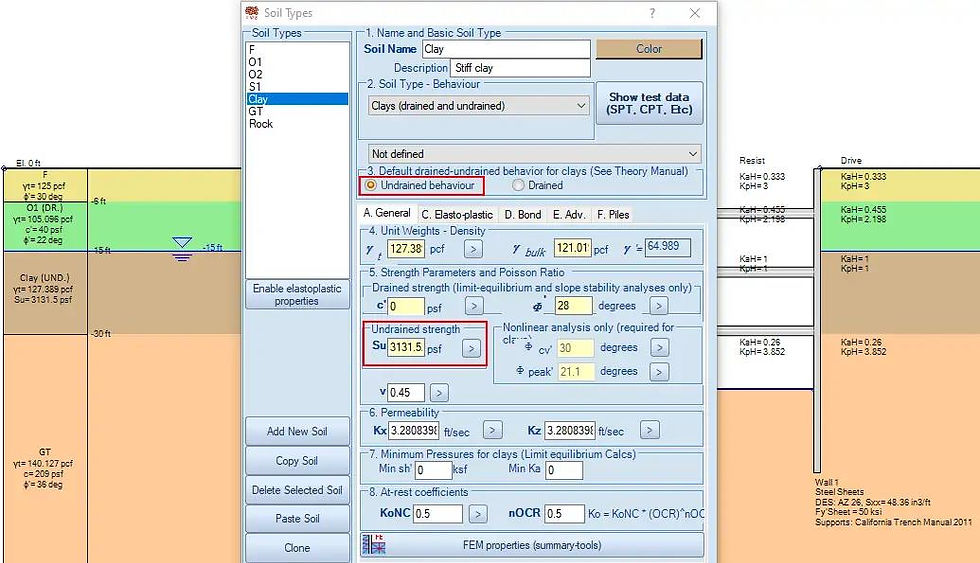
Undrained behavior is typically considered for clays located below the water table, where the clays are fully saturated. In this state, the clay does not have time to expel water from its pores, leading to a condition where the pore water pressure does not dissipate. In DeepEX, undrained clays are modeled using the undrained shear strength (Su), effectively ignoring the soil’s friction angle. For Limit Equilibrium Method (LEM) analysis, the software applies the defined Su value uniformly across the entire soil layer. In Non-Linear (NL) analysis, the specified Su acts as a maximum limit, and the actual shear strength may increase with depth due to factors such as the constant volume friction angle (PhiCV), peak friction angle (PhiPeak), and Over-Consolidation Ratio (OCR). Typically, the OCR for undrained clays ranges from 2 to 5, with 3 being a common choice. This approach captures the realistic behavior of undrained clays, ensuring accurate predictions of soil stability and deformation.

Drained Behavior of Clays
Drained behavior, on the other hand, is usually considered for clays located above the water table, where the clays are only partially consolidated. In this state, the clay has sufficient time to expel water from its pores, allowing the pore water pressure to dissipate. DeepEX models drained clays using the cohesion (c') and friction angle (phi) properties. These parameters are essential for representing the long-term strength and stability of the soil, as they account for the effects of effective stress. In scenarios where the water table fluctuates or the soil undergoes long-term consolidation, understanding the drained behavior is critical for predicting settlement and ensuring the integrity of geotechnical structures.

Examining Both Drained and Undrained Conditions
In some cases, it is necessary to examine both drained and undrained conditions for a comprehensive analysis. For instance, a submerged clay might initially be considered under undrained conditions, but it is crucial to predict its behavior under long-term drained conditions if the water table drops. To do this in DeepEX, follow these steps:
- Define All Relevant Clay Properties: Input the c', Su, and friction angle. Note that c' is typically much smaller than Su.
- Set Default Behavior: Configure the default behavior based on the clay’s location relative to the water table (undrained below the water table and drained above it).
- Add Additional Analysis Stage: After completing the primary stages, add one more stage where the behavior of all clays is switched from the default setting to drained. This option is available in the Analysis tab of the software.

By following these steps, engineers can simulate both short-term undrained and long-term drained conditions, providing a thorough understanding of the soil behavior and ensuring that geotechnical designs are robust and reliable.
Need more information? Contact us at support@deepexcavation.com


