

Can DeepEX add wall friction and adhesion to the models?
Updated: May 20
In DeepEX, engineers can model the interaction between retaining walls and surrounding soils not only through soil strength parameters, but also by specifying wall friction and adhesion. These parameters play an important role in evaluating the distribution of earth pressures, stability of the excavation system, and the performance of retaining walls under different soil and groundwater conditions.
By allowing direct input of wall friction and adhesion values, DeepEX provides engineers with the flexibility to adapt designs to project-specific geotechnical conditions and to comply with different national or international design standards.
Theoretical Background
The soil–wall interface is characterised by two key parameters:
Wall Friction (δ): Shear resistance mobilised along the wall–soil contact surface, often expressed as a fraction of the soil’s internal friction angle (ϕ’).
Adhesion (ca): The cohesive shear strength developed at the wall–soil interface, usually expressed as a proportion of the soil cohesion (in undrained conditions expressed relative to the undrained shear strength, su).
The magnitude of δ and ca depends on soil type, drainage conditions, wall material, and the applicable design code. Since interface strength is generally lower than the strength of the soil mass, design practice recommends limiting δ and ca to proportions of ϕ’ and su (or c in drained cohesive soils).
Typical Design Recommendations
Drained Conditions (Granular and Drained Cohesive Soils):
Clean sands and gravels:
– δ ≈ 0.5ϕ’ to 0.75ϕ’ (commonly δ = 2/3ϕ’).
– ca = 0 (no adhesion in purely granular soils).
Silts or sandy silts (drained behaviour):
– δ ≈ 0.3ϕ’ to 0.5ϕ’ (reduced due to particle smoothness and potential for interface slippage).
– ca ≈ 0.1c’ to 0.3c’ (if cohesion present).
Undrained Conditions (Cohesive Soils):
Soft to firm clays:
– δ is often ignored (δ = 0) in undrained analysis.
– ca ≈ 0.5su to 1.0su (commonly ca = α·su, with α between 0.5 and 1.0 depending on soil consistency and surface roughness).
Stiff to hard clays:
– δ may be included as a small fraction of ϕ’ (if a drained analysis is considered appropriate).
– ca typically limited to 0.3su to 0.5su in conservative design.
Rock or Cemented Materials:
• δ can approach ϕ’ (up to δ = ϕ’ for rough interfaces).
• ca may be taken equal to rock adhesion or contact bond strength, depending on surface preparation.
General Notes:
– Most design codes cap δ to prevent overestimation of interface strength (e.g., δ ≤ 20–30° even for coarse sands).
– Adhesion ca should generally not exceed soil shear strength (c’ or su as appropriate) and is often reduced for safety.
– Eurocode 7, FHWA, and BS 8002 all provide guidance and typical limiting values; engineers should check national annexes or regional practice for project-specific requirements.
Conditional Dependence on Wall Type
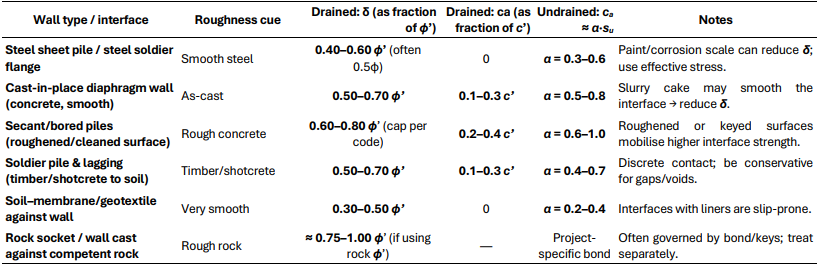
Interface parameters depend on surface material, roughness, and construction method, as presented in Table 1. Use the ranges below as starting points, then calibrate with site data and code limits.
Table 1 - Recommended Ranges by Wall Type.
Wall Friction and Adhesion in DeepEX
DeepEX allows users to define wall friction and adhesion through both the Model Wizard and the General Tab of the interface.
1. From the analysis tab.
When setting up a new model, users can assign wall friction and adhesion parameters directly to each wall type. This ensures that interface properties are considered from the start of the design process. This can be considered from the analysis tab, as presented in Figure 1. There is the option to consider null, a percentage of the friction or a specific value, for the wall friction.

2. Edit wall data
From the General Tab, users can refine or update wall friction and adhesion definitions for individual walls or for the project, by editing the wall data (Figure 2). This is especially useful in projects with mixed wall systems, layered soil profiles, or when adjusting design assumptions during sensitivity analyses.
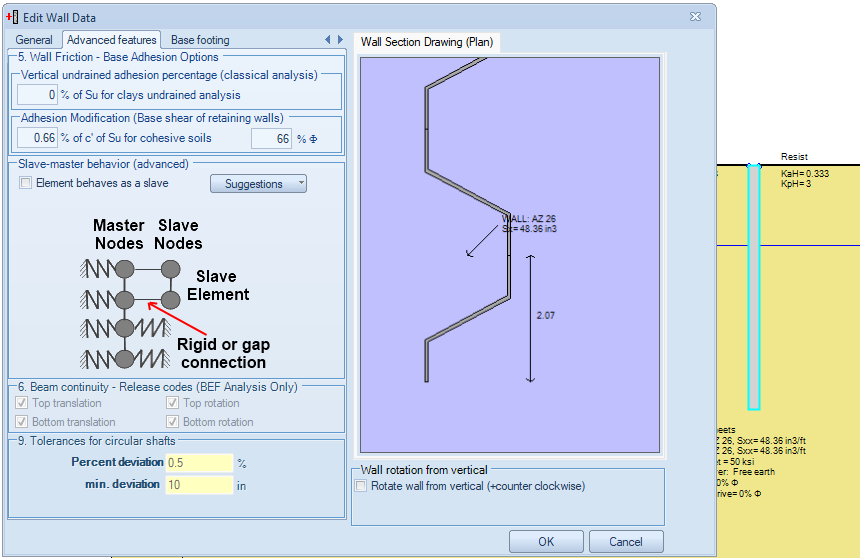
Available settings include:
User Selection – Manual entry of δ (°) and ca (kPa).
Code Presets – Automated input following design codes (e.g., Eurocode 7, FHWA, BS 8002).
Soil-Linked Values – Automatic scaling relative to soil shear strength parameters.
Advanced Settings – Ability to vary wall–soil interface parameters with depth or per soil layer.
[Insert Screenshot 3: Placeholder showing wall friction/adhesion options in General Tab]
Flexibility in Design
By providing both manual and automatic methods for defining wall friction and adhesion, DeepEX supports a wide range of geotechnical design approaches. Engineers can: Apply conservative defaults recommended by design codes. Tailor parameters to site investigation results or laboratory testing. Perform sensitivity studies by varying δ and ca across different soil layers. Ensure compliance with regional and international standards while maintaining flexibility for projectspecific assumptions. This flexibility helps streamline the design workflow while maintaining accuracy, adaptability, and transparency in the modelling process. Obs.: the wall type is also a conditional aspect on the definition of the wall friction of the adhesion.
Let us show you how to reduce your design time by up to 90%!


