

Basal Heave Analysis in Soft Clays
Basal Heave Calculations with DeepEX Software
Introduction
Basal heave is a well-documented failure mechanism in deep excavations constructed in soft to medium undrained clays. As excavation progresses, stress relief beneath the base may trigger upward movement of the clay, leading to sudden loss of stability. Classic failures reported by Bjerrum and Eide (1956) and later discussed by Terzaghi, Peck, and Mesri (1996) demonstrate that basal heave can occur even when wall movements and structural elements remain within acceptable limits.
DeepEX addresses this problem by combining classical limit equilibrium methods (LEM)—which form the basis of most design codes—with finite element analysis (FEM), which captures deformation mechanisms and soil–structure interaction in greater detail. This combined framework allows engineers to both verify safety and understand behaviour, which is essential for excavations in soft clays.
Theoretical Background of Basal Heave in Soft Clays
The classical interpretation of basal heave treats the excavation base as an undrained stability problem governed by the available shear strength of the underlying clay. Bjerrum and Eide (1956) described basal heave as a rotational failure mechanism extending beneath the excavation, driven by unloading and lateral confinement from retaining walls.
Later, Terzaghi and Peck (1967) and Terzaghi et al. (1996) formalised basal stability checks by relating excavation width, depth, and clay undrained shear strength through simplified analytical expressions. These approaches assume short-term undrained conditions and uniform soil properties and remain widely used in practice due to their transparency and conservative nature.
More refined analytical formulations, including Prandtl-type solutions, have been adapted for basal heave evaluation in cohesive soils and are incorporated in several design recommendations and codes (e.g. Duncan, Wright, and Brandon, 2014). Circular failure mechanisms, analogous to slope stability analyses but constrained by excavation geometry, are also commonly used to assess basal instability.
While these LEM approaches provide explicit factors of safety, they rely on idealised failure mechanisms and cannot explicitly capture stress redistribution, progressive yielding, or interaction with structural elements. These limitations motivated the increasing use of FEM for excavation analysis, as discussed by Clough and O’Rourke (1990).
Model Description and Analysis Approach in DeepEX
The example analysed in DeepEX represents a braced excavation constructed in layered soil conditions consisting of fill, sand, and multiple undrained clay layers underlain by rock, as described in Table 1. A sheet pile wall system with internal supports is used to control lateral deformations.
Table 1- Soil Stratigraphy and parameters.
Layer | Material Description | Depth Range (m) | γ (kN/m³) | Su (kPa) | φ′ (°) | Behaviour |
Fill | Made ground | 0 to -1 | 18 | — | 30 | Drained |
Clay 1 | Soft clay (UND) | -1 to -4 | 20 | 35 | 0 | Undrained |
Sand | Medium dense sand | -4 to -10 | 21 | — | 34 | Drained |
Clay 2 | Firm clay (UND) | -10 to -17.5 | 20 | 45 | 0 | Undrained |
Clay 3 | Stiff clay (UND) | -17.5 to -27.5 | 20 | 60 | 0 | Undrained |
Rock | Weathered rock | below -27.5 | 27 | — | 30 | Drained |
Figure 1 illustrates the DeepEX excavation model, highlighting the stratified soil profile, the supported excavation geometry, and the relative position of the groundwater table. These features form the basis for the basal heave assessment performed using both LEM and FEM approaches. This exploratory study considers a 10 m deep excavation with fixed supports ad the depths represented in the model (1.5 m, 4 m, and 8 m).
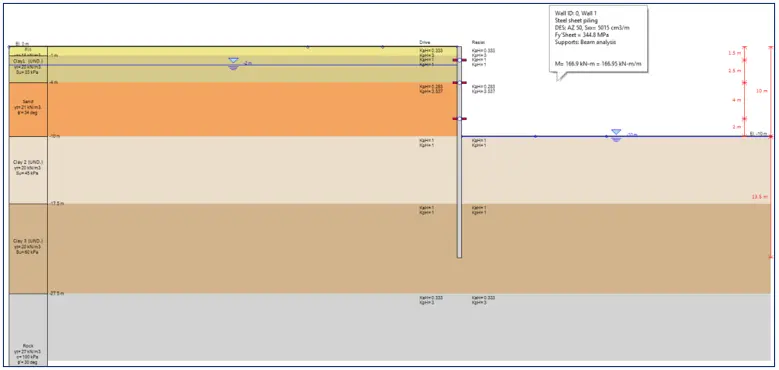
Figure 1- Excavation model with geometry and excavation.
Two complementary analyses are performed:
Limit Equilibrium Analysis (LEM)
DeepEX evaluates basal heave using multiple recognised formulations, including standard basal stability checks, Prandtl-based solutions, and circular failure mechanisms. These checks follow the conceptual framework proposed by Bjerrum and Eide (1956) and later adopted in practical design guidance (Terzaghi et al., 1996). Factors of safety are calculated for each excavation stage, reflecting the short-term undrained condition.
Finite Element Analysis (FEM)
A staged FEM analysis is carried out to model excavation sequencing, wall installation, groundwater conditions, and soil response. Clay layers are treated as undrained during excavation, consistent with the assumptions underlying classical basal heave theory. FEM is used here as a deformation-based tool, in line with the approach advocated by Clough and O’Rourke (1990), rather than as a direct substitute for analytical stability checks.
Results and Interpretation
Limit Equilibrium Basal Heave Results
The limit equilibrium (LEM) basal heave assessment in DeepEX evaluates the stability of the excavation base using multiple recognised analytical formulations. These methods idealise basal heave as a rotational or translational failure mechanism within the underlying soft clay layers and compute a factor of safety by comparing available undrained shear resistance to the driving forces induced by excavation unloading and surcharge effects.
In this example, the results indicate that basal stability is governed by short-term undrained conditions. The minimum factor of safety against basal heave is slightly above unity, suggesting marginal stability at the analysed excavation stage. While circular failure mechanisms yield higher safety factors, planar and standard basal heave formulations are more critical and therefore govern the design. This highlights the importance of considering multiple LEM methods rather than relying on a single formulation, as recommended by authors such as Bjerrum & Eide (1956), Terzaghi (1943), and later refinements by Peck (1969) for deep excavations in soft clays.
Figure 2- Basal Heave – Limit Equilibrium Results Summary.
Method / Check | Factor of Safety |
Minimum FS (governing) | 1.087 |
Embedment safety | 1.302 |
Passive resistance safety | 2.378 |
Rotational failure (FS Rot.) | 1.084 |
Circular failure surface | 1.589 |
Basal heave – Standard method | 1.371 |
Basal heave – Prandtl (method 1) | 1.140 |
Basal heave – Prandtl (method 2) | 1.223 |
Basal heave – Circular | 1.589 |
Hydraulic uplift (FS HYD) | 1.568 |
OBS: For design purposes, the lowest factor of safety should be adopted as the governing value, while higher values from alternative mechanisms provide useful context for understanding the range of possible failure modes. In the present study the safety factor against rotation (1.084) is the conditional for excavation safety and this aspect should be taken into consideration.
Figure 2 presents the results of the limit equilibrium basal heave analysis for the excavation in soft clay, as implemented in DeepEX. The figure illustrates the critical basal failure mechanism assumed in the LEM framework, together with the distribution of resisting and driving forces beneath the excavation. The shaded zone represents the governing failure surface extending below the excavation base, consistent with classical basal heave mechanisms described by Terzaghi (1943) and Bjerrum & Eide (1956).

Figure 2- Limit equilibrium basal heave analysis results for the excavation in soft clay, showing the governing basal failure mechanism and the calculated factors of safety from the different LEM methods implemented in DeepEX (standard, Prandtl-based, circular, and hydraulic uplift checks).
Interpretation for Design
The results show that basal heave stability is borderline, with several methods yielding factors of safety close to 1.0. In practice, this would warrant careful consideration of excavation staging, groundwater control, or mitigation measures such as increased embedment depth, berms, or ground improvement. These LEM results form the primary basis for stability verification, while FEM results can be used to assess deformation patterns and confirm the plausibility of the predicted failure mechanism.
Finite Element Results
The FEM displacement contours show upward movements beneath the excavation base, with maximum vertical displacements developing within the soft clay layers. The deformation pattern forms a bulb-shaped zone beneath the excavation, consistent with basal heave mechanisms observed in centrifuge tests and field measurements reported by Clough and O’Rourke (1990).
As excavation progresses, FEM results indicate increasing shear strain localisation and stress redistribution beneath the excavation, particularly near the wall toe. In stages where LEM predicts failure, FEM shows rapidly increasing displacements, supporting the analytical interpretation rather than contradicting it.
Figure 3 presents the FEM-predicted total displacement field at the final excavation stage. The colour contours represent the magnitude of the total displacement, while the arrows indicate the displacement vectors and direction of ground movement. The results show a pronounced concentration of displacements beneath the excavation base and immediately behind the retaining wall, consistent with the development of basal heave in the underlying soft clay. The upward and inward displacement vectors highlight the mobilisation of undrained shear deformation as the excavation unloads the clay layer. The extent and shape of the displacement bulb correlate well with the critical failure mechanisms identified in the limit equilibrium basal heave analysis, providing confidence in the interpreted deformation mechanism.

Figure 3. Finite Element Analysis results showing total displacement contours and displacement vectors for the excavation in soft clay.
Figure 4 illustrates the vertical displacement component obtained from the FEM analysis, with colour contours representing upward and downward ground movements. Significant upward vertical displacements are observed beneath the excavation base, indicating the tendency for basal heave driven by stress relief in the soft clay strata. Downward movements behind the wall reflect stress redistribution and compatibility effects associated with wall deformation and soil–structure interaction. The vertical displacement pattern clearly identifies the zone of maximum heave and provides a deformation-based confirmation of the stability concerns highlighted by the LEM basal heave factors of safety. While FEM does not provide a direct factor of safety, the magnitude and distribution of vertical displacements offer valuable insight into the severity and progression of the failure mechanism.

Figure 4. Finite Element Analysis results showing vertical displacement (uz) contours for the excavation.
Discussion: Complementary Roles of LEM and FEM
The results presented in this example clearly demonstrate the value of combining limit equilibrium methods (LEM) and finite element modelling (FEM) for the assessment of basal heave in soft clays.
LEM-based basal stability checks, rooted in the pioneering work of Bjerrum and Eide (1956) and later formalised by Terzaghi, Peck, and Mesri (1996), provide explicit and transparent factors of safety against basal heave. These methods remain essential for design verification, regulatory compliance, and comparative assessment of excavation stages. In the present case, the range of basal heave safety factors obtained using different formulations highlights both the sensitivity of the problem and the importance of evaluating multiple recognised analytical approaches.
FEM, as emphasised by Clough and O’Rourke (1990), complements these analytical checks by offering a deformation-based perspective that cannot be captured by LEM alone. The FEM results clearly illustrate the development of upward displacements beneath the excavation base, stress redistribution around the retaining wall, and the progressive mobilisation of undrained shear strains in the clay layers. The displacement vectors and vertical displacement contours provide direct insight into the geometry and extent of the basal heave mechanism, as well as the influence of excavation geometry and groundwater conditions.
It is important to note that FEM should not be used in isolation as a replacement for classical basal stability checks. While FEM provides valuable insight into soil–structure interaction, construction staging effects, and deformation compatibility, it does not yield a direct factor of safety. Instead, FEM should be used to interpret the physical realism of the response, identify zones of potential progressive instability, and support engineering judgement, particularly in cases where LEM safety margins are low or close to unity.
Conclusions
Basal heave in soft clays remains a critical and often governing failure mechanism for deep excavations under undrained conditions. The fundamental theoretical framework developed by Bjerrum and Eide (1956) and further refined by Terzaghi et al. (1996) continues to underpin modern geotechnical design practice and remains directly relevant to contemporary excavation projects.
This study demonstrates that DeepEX effectively integrates these well-established analytical methods with advanced FEM capabilities, enabling engineers to evaluate basal stability using recognised factors of safety while simultaneously visualising deformation patterns, stress redistribution, and soil–structure interaction. The combined use of LEM and FEM leads to a more comprehensive understanding of excavation performance, allowing critical failure mechanisms to be identified early and mitigation measures to be assessed with greater confidence.
By unifying analytical verification and numerical insight within a single modelling environment, DeepEX supports more robust, transparent, and defensible designs for deep excavations in soft ground, allowing engineers to move beyond isolated checks and toward a truly integrated stability assessment framework.
References
Bjerrum, L., & Eide, O. (1956). Stability of strutted excavations in clay. Géotechnique, 6(3), 115–128.
Terzaghi, K., Peck, R. B., & Mesri, G. (1996). Soil Mechanics in Engineering Practice. 3rd ed., Wiley.
Clough, G. W., & O’Rourke, T. D. (1990). Construction induced movements of in-situ walls. ASCE Specialty Conference on Design and Performance of Earth Retaining Structures.
Duncan, J. M., Wright, S. G., & Brandon, T. L. (2014). Soil Strength and Slope Stability. 2nd ed., Wiley.
Eurocode 7 (EN 1997-1). Geotechnical design – General rules.
Let us show you how to reduce your design time by up to 90%!


