

Long-Term Failure of a Cutting in Brown London Clay
- Aug 4, 2025
- 4 min read
Updated: Oct 6, 2025
A Case Study from 1841
Introduction
One of the earliest documented deep railway cuttings in London Clay was excavated in 1838 at New Cross for the London & Croydon Railway. As noted by Skempton in his seminal paper Slope Stability of Cuttings in Brown London Clay, the line was opened in 1839, and just two years later, on 2 November 1841, a massive landslide occurred. Nearly 40,000 cubic metres of clay slipped within four hours, blocking the line. While clearance operations were still ongoing, a second major failure took place on the opposite slope. Eventually, the cutting was stabilised through extensive earthworks and re-profiling with wide benches.
Skempton (1964) and Gregory (1844) both report that the failure occurred along the base of the weathered brown London Clay, above the more resistant blue clay, which itself sits atop the Woolwich and Reading Beds. Importantly, this case exemplifies a fundamental behaviour of fine-grained soils: slopes in overconsolidated clays often remain apparently stable in the short term (in an undrained state) but gradually lose strength over time as pore pressures dissipate and the material transitions to its drained condition.
This article revisits the New Cross cutting failure using DeepEX software to demonstrate how such long-term failures can be effectively modelled using Limit Equilibrium Methods (LEM) with appropriate assumptions for both short-term (undrained) and long-term (drained) shear strength. The analysis confirms the observed mechanism and highlights the difference in safety margins across time.
Geology and Soil Properties
The stratigraphy at the site, as described by Gregory (1844), Skempton (1964), and Chandler & Skempton (1974), consists of:
- Brown London Clay (weathered, upper layer).
- Blue London Clay (stiffer, more intact layer).
- Woolwich & Reading Beds (underlying basal layer).
The following soil parameters were adopted for the slope stability analysis (Table 1):
Table 1 – Soil properties.
Layer | γ (kN/m³) | ϕ′ (°) | c’ (kPa) | Su (kPa) |
Brown London Clay | 18.5 | 20 | 1.5 | 80 |
Blue London Clay | 19 | 22 | 5 | 175 |
Woolwich & Reading Beds | 21 (sat.) | 28 | 20 | 320 |
Slope Geometry and Numerical Model
The geometry of the cutting was reconstructed based on the descriptions from the literature. The slopes were originally cut steep, with approximate side slopes near 11/2:1 or slightly flatter (Figure 1). The slip surface was reported to follow the base of the brown London Clay.
 |
Figure 1: Reconstructed slope geometry and stratigraphy |
A slope stability model was developed in DeepEX using the Morgenstern-Price method. The model included both undrained and drained analyses to capture the transition in soil behaviour over time.
 |
Figure 2: DeepEX model showing the model used for slope stability analysis |
Results
Short-Term (Undrained) Condition
- Analysis using undrained shear strength values (cu) for all clay layers
- Factor of Safety (FoS) = 1.673
- The slope appears stable, consistent with the lack of immediate failure post-construction (Figure 3).
 |
Figure 3 – Failure mechanism obtained from the short-term stability analysis. |
Long-Term (Drained) Condition
- Analysis using effective stress parameters (ϕ′ and c′)
- Factor of Safety (FoS) = 0.68
- Failure surface matches the historical slip geometry, passing through the lower interface of the brown London Clay (Figure 4).
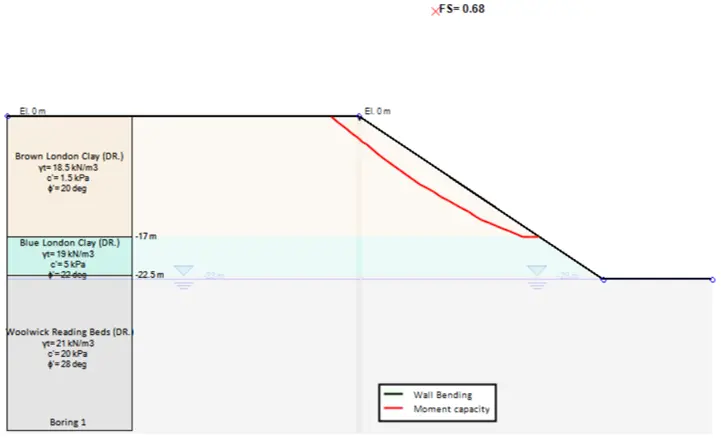 |
Figure 4: Collapse mechanism (DeepEX). |
Discussion
The simulation aligns closely with the real-world failure, demonstrating how long-term stability in fine-grained soils is governed by effective stress behaviour. Initially, the slope would have seemed safe due to the relatively high undrained shear strength of the brown clay. However, as pore pressures dissipated, the true (drained) strength parameters governed the stability, leading to delayed collapse.
This case study highlights the importance of accounting for both undrained and drained conditions when evaluating the performance of cuttings in overconsolidated clays. The short-term analysis is important to guarantee that the cutting operations are safe and the long-term is important because it evaluate the performance of the slope over time. The DeepEX model not only captured the slip surface observed historically but also demonstrated how changes in soil behaviour over time can drive a slope from a state of apparent safety (FoS > 1.5) to instability (FoS < 1).
Conclusion
The 1841 New Cross cutting failure remains a landmark example of delayed failure in clay cuttings. Using modern tools such as DeepEX, engineers can recreate and understand historical failures with clarity. This case illustrates how long-term stability in clay slopes must be carefully evaluated using drained parameters, even when short-term undrained behaviour suggests safety. DeepEX proves to be a reliable tool for this purpose, capturing realistic failure mechanisms and providing insight into the evolution of slope conditions over time.
References
Chandler, R. J., & Skempton, A. W. (1974). The design of permanent cutting slopes in stiff fissured clays. Géotechnique, 24(4), 457–466.
Gregory, W. (1844). Account of the Slips in the New Cross Cutting on the London and Croydon Railway. Proceedings of the Institution of Civil Engineers.
Hooper, J. A., & Butler, F. G. (1971). Some Numerical Results Concerning the Shear Strength of London Clay. Géotechnique.
Morgenstern, N. R., & Price, V. E. (1965). The Analysis of the Stability of General Slip Surfaces.
Skempton, A. W. (1964). Slope Stability of Cuttings in Brown London Clay. Géotechnique, 14(2), 77–101.
Let us show you how to reduce your design time by up to 90%!


