

🌍Geoengineering Master Class #4
Why Construction Staging Is Critical in FEM Analysis and How DeepEX Makes It Practical
Introduction
Finite Element Analysis (FEM) has become an essential tool in geotechnical engineering, especially for deep excavations and underground structures. FEM allows engineers to capture soil–structure interaction, stress redistribution, and deformation patterns with a level of detail that simpler methods cannot provide.
However, the accuracy of FEM does not depend only on soil models or mesh quality. One of the most critical — and often underestimated — factors is how the construction sequence is modeled.
In this Master Class, we focus on the significance of construction staging in FEM analysis, and more importantly, how you can realistically include detailed excavation stages without turning the modeling process into a time-consuming burden. Using DeepEX, you’ll see how detailed staging can be implemented efficiently, allowing FEM results to reflect real construction behavior rather than an idealized final condition.
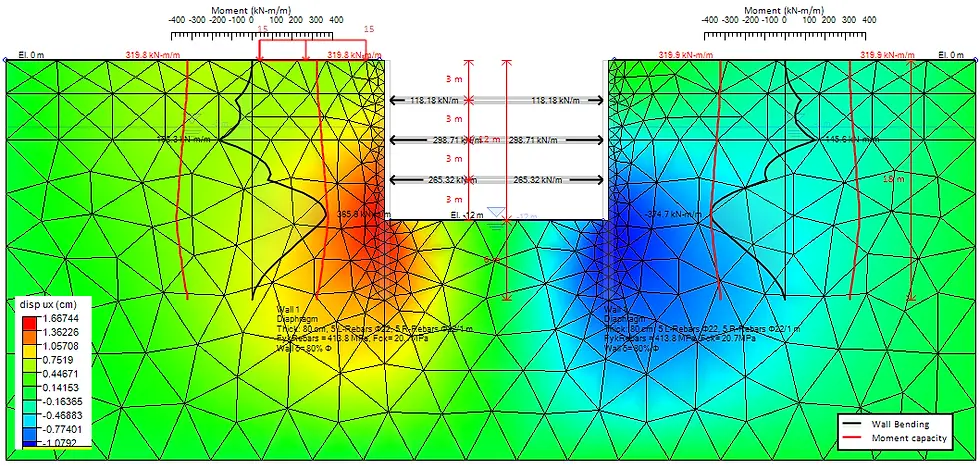
Figure 1: DeepEX FEM results: Wall Moments, support reactions, soil mass displacements
Why Construction Staging Matters in FEM
Unlike traditional limit equilibrium approaches, FEM does not simply evaluate a single “final” configuration. Instead, it tracks how stresses, strains, and displacements develop progressively as construction advances.
In deep excavations, this distinction is crucial. Excavation does not happen instantaneously, nor does the support system activate all at once. Soil is removed in steps, supports are installed sequentially, groundwater conditions may change, and stresses are continuously redistributed.
If these intermediate stages are ignored, FEM may produce results that appear reasonable but fail to capture:
Accumulated wall deformations from earlier excavation phases
Load redistribution between soil and supports over time
The true mobilization of structural stiffness
The effect of temporary unsupported excavation stages
In practice, this often leads to underestimation of wall displacements, bending moments, and support reactions — precisely the quantities engineers rely on to assess performance and safety.
A Teaching Example: Excavation with Internal Bracing
In the Master Class video, we examine a 12 meters deep excavation supported by struts, modeled using FEM in DeepEX. The focus is not on a single result, but on understanding how results evolve depending on how construction staging is handled.
Two modeling philosophies are discussed conceptually:
One that includes all intermediate excavation and support installation stages
Another that simplifies the process by skipping intermediate stages and jumping between major milestones
Rather than treating this as a purely academic comparison, the lesson emphasizes what this means from an engineering perspective. You’ll see how each excavation step contributes to:
Progressive wall movement
Stress accumulation in the soil
Increasing demand on support systems
By observing results stage by stage, it becomes clear that FEM is not just a “final-state calculator,” but a time-history simulation of construction behavior.
The Role of Construction Stages in Realistic FEM Results
Detailed staging allows FEM to realistically capture several critical mechanisms:
As excavation proceeds, soil stresses are released gradually, not instantly. This gradual unloading affects how and when wall movements occur. If excavation stages are skipped, the model artificially stiffens the system and suppresses early deformations.
Support systems such as struts, anchors, or slabs only begin to carry load after they are installed. FEM staging ensures that these elements are activated at the correct time, allowing forces and moments to develop naturally rather than being imposed unrealistically.
Groundwater and pore pressures can also evolve during construction. Even when groundwater is simplified, the timing of excavation still influences effective stresses and deformation patterns.
Ultimately, FEM staging allows engineers to understand not just whether a system is stable, but how it reaches that state.
Why Detailed Staging Is Often Avoided — and Why It Shouldn’t Be
Despite its importance, detailed construction staging is often simplified or omitted in FEM models. The reason is not lack of awareness, but practical limitations. In many FEM tools, defining dozens of stages manually can be tedious, error-prone, and time-consuming.
This is exactly where DeepEX changes the workflow.
DeepEX is designed specifically for excavation problems, which means construction staging is not an afterthought — it is built into the core of the software. Users can:
Automatically generate detailed excavation stages using model wizards
Easily modify, insert, or remove stages as design evolves
Review results at every individual construction stage
Maintain consistency between LEM, NL, and FEM models
In addition, advanced tools such as voice commands and automated workflows allow users to create complex, staged excavation models in a fraction of the time traditionally required.

Figure 2: DeepEX FEM results comparison - All stages included vs excavation stages omitted
Seeing the Value: Results by Stage, Not Just at the End
One of the key teaching points in this Master Class is learning how to read FEM results properly. Instead of focusing only on the final excavation stage, DeepEX allows you to:
Track wall displacements as they accumulate
Observe how bending moments evolve after each excavation step
Identify which stages govern support forces
Detect potential serviceability issues early in construction
This stage-by-stage insight is often what separates a “theoretically stable” design from a constructible and predictable one.
Key Takeaway
Construction staging is not an optional refinement in FEM analysis — it is fundamental to producing realistic, defensible results for deep excavations. FEM models that ignore staging may look efficient, but they often mask the very behaviors engineers are trying to understand.
DeepEX makes detailed construction staging practical, accessible, and efficient, allowing you to focus on engineering judgment rather than software mechanics. By combining automated staging, powerful FEM capabilities, and clear result visualization, DeepEX enables engineers to model excavation behavior as it truly occurs in the field.
Coming Next in the Geoengineering Master Class
Future lessons will continue to focus on practical geotechnical modeling workflows — showing not only how to run analyses, but how to interpret them correctly and apply them confidently in real projects.
Stay tuned for the next Master Class episode.
Let us show you how to reduce your design time by up to 90%!


